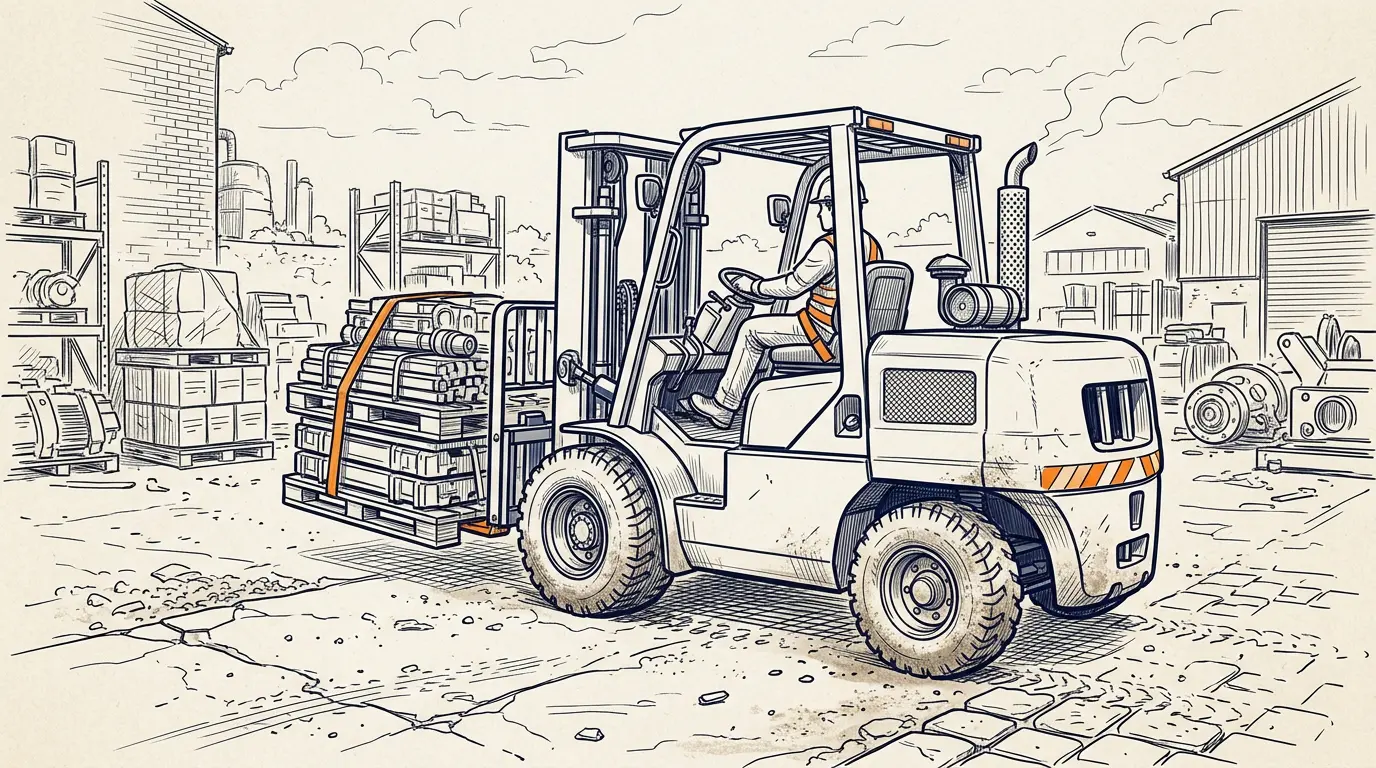
The same 3,000 kg forklift chassis ships with two drawbar-pull ratings — 1,650 or 2,000 kg — depending on which engine the factory bolts on.
If you run construction sites, cement or stone yards, ports, or a multi-shift plant, that gap decides more than comfort. It is the difference between a budget alternative that survives your duty cycle and one that grenades a drive axle in its second year.
The instinct to trust a known badge over an unknown one is reasonable. A badge is a proxy for the numbers, though, not a substitute for reading them.
A cheaper alternative isn't a downgrade if you hold it to the same six specifications Lonking or Hangcha publish for that tonnage class. The risk was never the brand. It is skipping the verification.
How to Define High-Intensity Forklift Duty in Hours
High-intensity duty starts around 3,000 operating hours a year — the load a two-shift operation puts on a truck. A single shift of five days a week, at six productive hours each, reaches only about 1,500.
A diesel forklift carries a 10,000 to 12,000-hour design life under ordinary conditions. Run it two shifts in an outdoor, dusty, or corrosive yard and you compress that life into three or four calendar years instead of seven or eight.
Pin your own number before you shop. A truck built for 1,500 hours a year and one built for 3,000 can wear the same badge and the same rated capacity. The cheaper one is a genuine bargain at 1,500 hours and a liability at 3,000.
The six parameters below only earn their keep once you know which side of that line you sit on.
Six Forklift Specs to Match Against the Benchmark
Six specifications decide whether an alternative matches a Lonking or Hangcha benchmark under load: rated capacity and load center, laden gradeability, max drawbar pull, low-RPM engine torque, transmission and drive-axle provenance, and mast steel structure. Pull the benchmark's published figures for each, then demand the same line items from the candidate — not a tonnage number and a photo.
| Specification | What the number governs | How to verify against the benchmark |
|---|---|---|
| Rated capacity at load center | Safe lift at a stated load center | Match capacity AND load center; a higher center cuts real capacity |
| Laden gradeability (%, loaded) | Ramp climb with a full load | Compare the loaded %, never the empty figure |
| Max drawbar pull (kg, loaded) | Force to move off a dead stop | Demand the loaded kg figure, not rated capacity |
| Low-RPM engine torque | Whether a laden truck starts moving | Read N·m at 1,200-1,700 rpm, not peak kW |
| Transmission & drive-axle provenance | Duty-cycle survival, repair cost | Ask which OEM supplies each, not the hood badge |
| Mast steel structure | Lift stability and mast lifespan | Section profile and plate thickness, not just height |
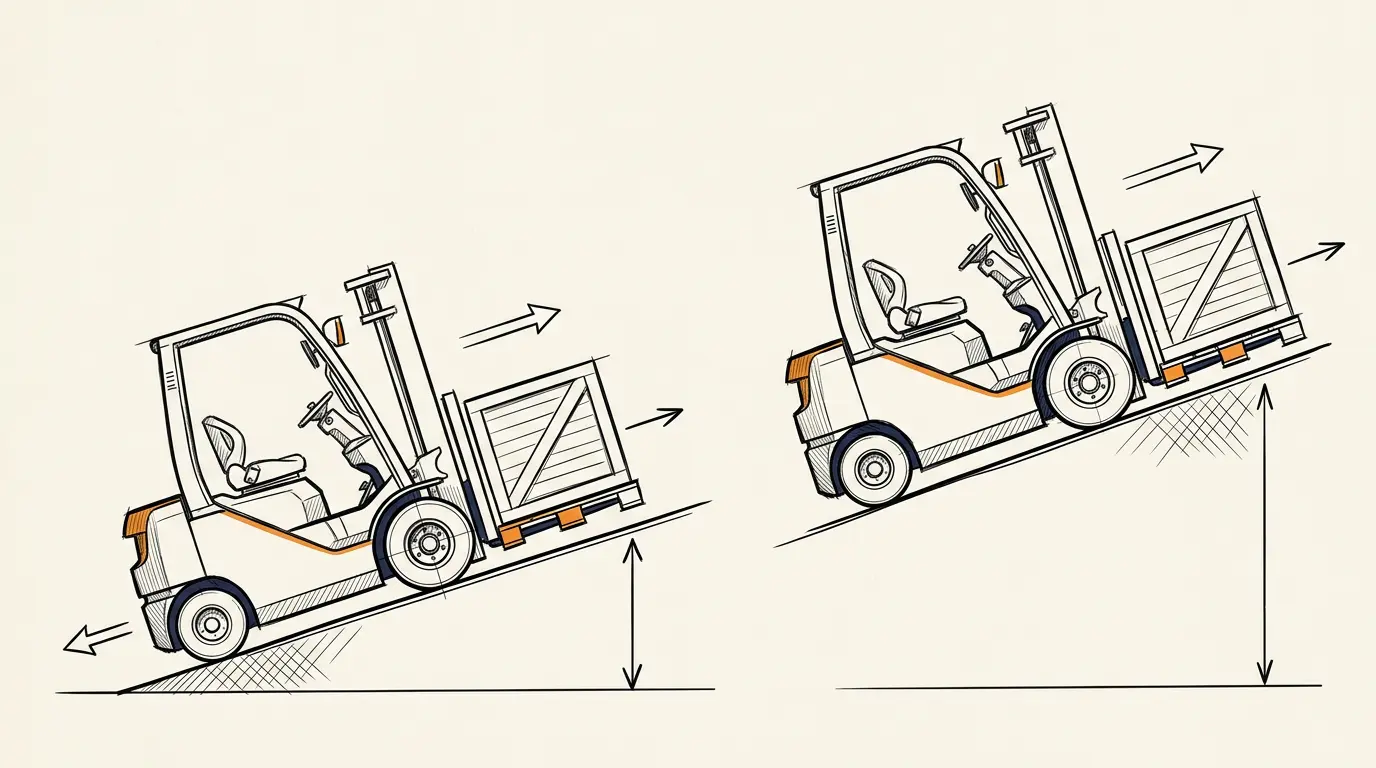
Take LiuGong's published CPCD30 sheet, a 3-ton diesel in the same class as Lonking's and Hangcha's own 3-tonners. The same rated 3,000 kg chassis is offered with four engines. Fit the Xinchai and you get 1,650 kg of drawbar pull and 18% laden gradeability; fit the Isuzu, Yanmar, or Nissan and the identical truck delivers 2,000 kg and 20%.
A 350 kg swing in pushing force and two points of grade sit on one nameplate. Read only the capacity line and both trucks look equal on paper.
Engine torque is where the paper trick hides. A laden diesel needs roughly 80% of its peak torque down at 1,200 rpm just to pull off a dead stop, and peak kW at 2,300 rpm never touches that moment.
The Yanmar option on that sheet makes 196 N·m at 1,700 rpm. A headline kW rating alone would not tell you which engine actually moves the load up a ramp.
Mast steel is the spec buyers eyeball and skip. Match the section profile and plate thickness, not just the lift height. A taller three-stage mast built from thinner steel racks more under load, and its extra hoses cut sightlines through the uprights.
Yuli's own CPC-K series publishes the same line items — a CPC30-K lists 39 kW and 160 N·m at 20% laden gradeability. Hold those numbers to the same test you would give any brand, ours included.
Which Forklift Specs You Can Safely Cheap Out On
The safe place to cut cost is comfort and convenience — cab trim, heater, deluxe seat, lighting, and paint — never the powertrain that moves the load. Engine, transmission, drive axle, and mast steel are the four line items that decide duty-cycle survival, and every dollar saved there comes back as downtime.
| Configuration | Cost-cut verdict | Why |
|---|---|---|
| Engine torque curve | Never | Low-RPM torque moves the laden truck |
| Transmission & drive axle | Never | Governs failure interval and repair cost |
| Mast steel structure | Never | Structural wear sets mast lifespan |
| Operator cab & heater | Defer | Comfort, no duty-cycle effect |
| Lighting & seat upgrade | Defer | Convenience only |
| Paint & cosmetic trim | Defer | Zero load impact |
Transmission choice is a real tradeoff, not a simple upgrade. A hydrostatic unit runs about 8,000 hours between failures but costs 40 to 50% less to repair; a powershift box runs closer to 12,000 hours, yet each repair costs more. Neither wins on cost alone — the right one depends on your hours and whether you fix trucks in-house.
Buyers fixate on the sticker gap. Industry estimates put the premium for a tier-one badge somewhere in the 15 to 30% range over a factory-direct equivalent. That spread means little next to running cost — maintenance runs $1,000 to $3,000 a year, fuel another $1,500 to $4,000.
A cheaper truck that eats an extra gearbox is the expensive one. Cut the cab, keep the driveline, and you never buy the savings back in shop invoices.
The Forklift Spec-Match Checks to Run Before You Buy
A published spec sheet earns a purchase order only after the truck backs it up. Run four acceptance checks before you sign: a loaded pull-and-ramp test against the sheet's figures, a mast wear inspection, a written provenance trail for the driveline, and a spare-parts commitment in the contract.
1. Load test the driveline. Put a rated load on the forks and confirm the truck pulls the published drawbar figure and climbs the stated grade. The spec sheet is marketing; the factory test report is evidence.
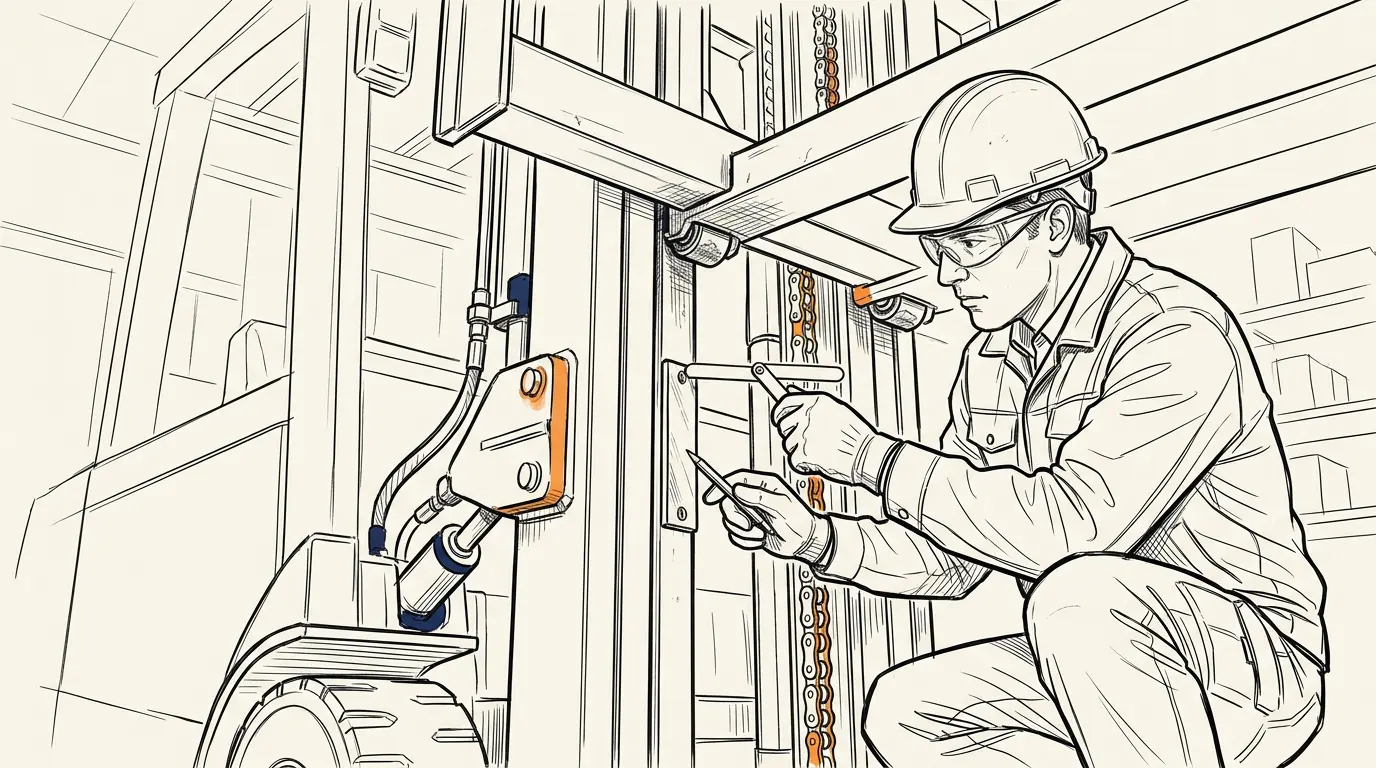
2. Inspect the mast for structural wear, not lubrication. Mast jitter is a steel problem — a widened gap between the sliding plates, not a dry cylinder. Reject any unit where wheel or roller groove wear exceeds 10% of the original dimension or chain pitch has stretched past 4%.
3. Get the driveline provenance in writing. Name the OEM for the engine, transmission, and drive axle, and get a CE certificate — the badge on the hood tells you nothing about who built the axle underneath.
4. Pin down spare parts before price. An engineering failure-analysis case describes a forklift axle shaft snapping after just 296 hours from a heat-treatment defect — the kind of fault that surfaces only in service, when parts availability decides your downtime. Ask who stocks the spare parts before you ask the price.
Clear those four and a budget alternative stops being a gamble. It becomes a documented equal.
Run the Check Before the Invoice
Start with your annual operating hours. Then pull the benchmark's six published figures — capacity and load center, gradeability, drawbar pull, low-RPM torque, driveline provenance, and mast steel. Make the candidate answer each one in writing, backed by a load test on the yard.
A factory-direct truck from a name you haven't heard of can carry the same load up the same ramp for years. The parameters decide that, not the reputation on the counterweight — the only failure mode that matters is nobody checking before the money moves.
Run the numbers over five years, not at the invoice, and a genuine alternative proves itself on paper long before it reaches your yard.