A 3-ton diesel forklift built for a construction yard and one built for a foundry floor carry the same rated capacity on the badge. They fail in opposite ways within their first season on site.
The nameplate number tells you little about whether a truck survives your conditions. The option package matched to those conditions does. Rated capacity is measured at a 500 mm load center — your load probably isn't.
Spec in one order and the budget holds. Fix the environment's measurable requirements first: temperature, dust load, duty cycle, refueling or charging access.
Choose the power type that meets them at the lowest total cost, then price options. Personnel safety sits outside that sequence, as its own baseline.
Spec'ing for Cold Storage
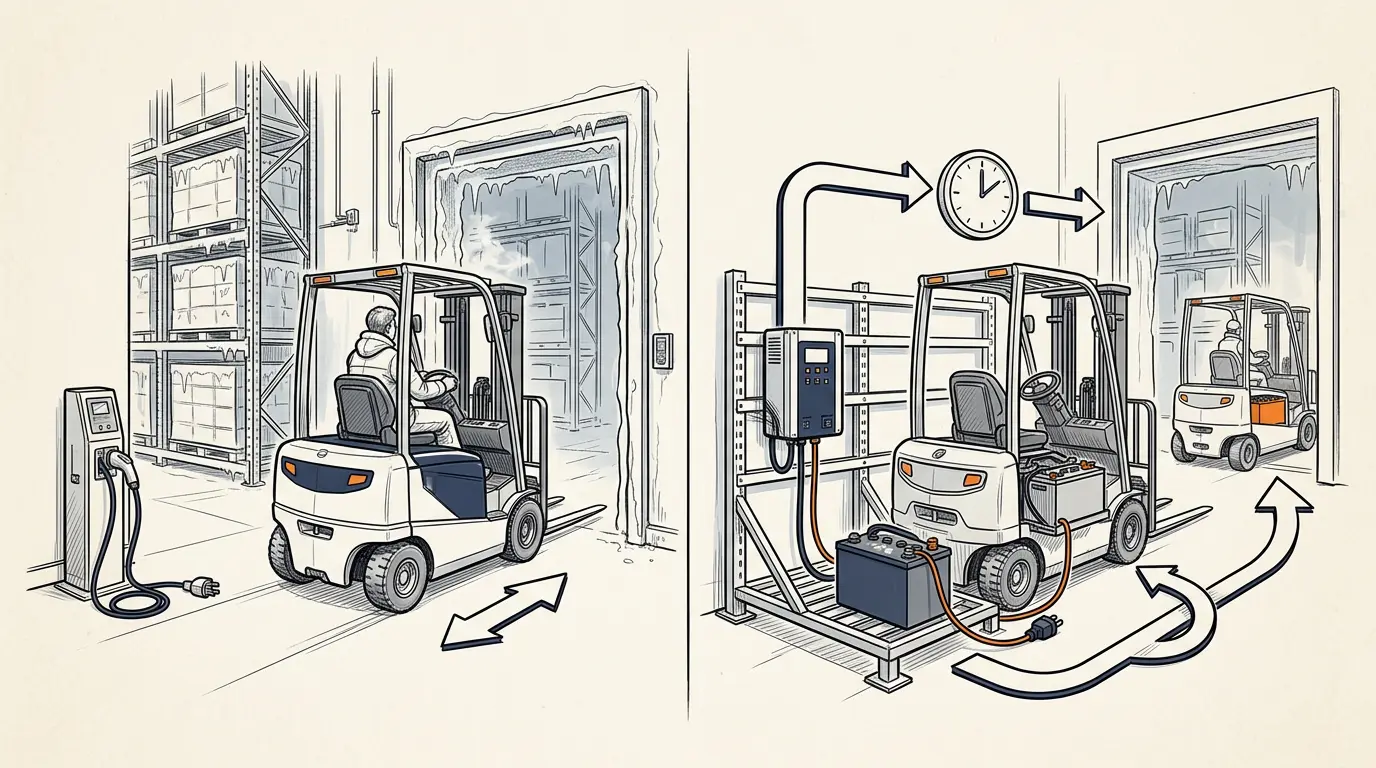
In continuous-duty cold storage, the environment forces electric power — specifically lithium — because recharge speed, not running efficiency, decides the truck.
Lithium recharges in one to three hours and lasts 3,000 to 5,000 charge cycles. A lead-acid pack needs 8 to 12 hours to charge, then 6 to 8 more to thaw, and gives out at 1,000 to 1,500 cycles.
Lead-acid also loses capacity in the cold — roughly 20% at freezing, close to half at -30°C. A LiFePO4 pack rated from -25°C to 55°C sidesteps that arithmetic.
I spec'd 3.5-ton lithium trucks for an auto-parts plant running 24/7 on the North American border. Only lithium's recharge speed kept trucks on the floor across three shifts; the choice was never "electric versus diesel."
The cold-storage spec then splits into mandatory and situational:
- Sealed, moisture-protected electronics and connectors — mandatory, since condensation corrodes unprotected contacts.
- Cold-rated hydraulic fluid, seals, and lubricants — mandatory for sub-zero work.
- Cockpit or cab heater — situational, only for operators shuttling to a warm dock.
A lithium-equipped unit in the 2-to-3.5-ton class, like Yuli's CPD and CPE electric series with the cold-storage option, covers most freezer duty.
Electric stops being forced only in a single-shift cold room that can absorb an overnight charge, where lead-acid with a spare pack still works. The duty cycle removes the choice, not the temperature alone.
Spec'ing for Heat, Dust, and Foundry Floors
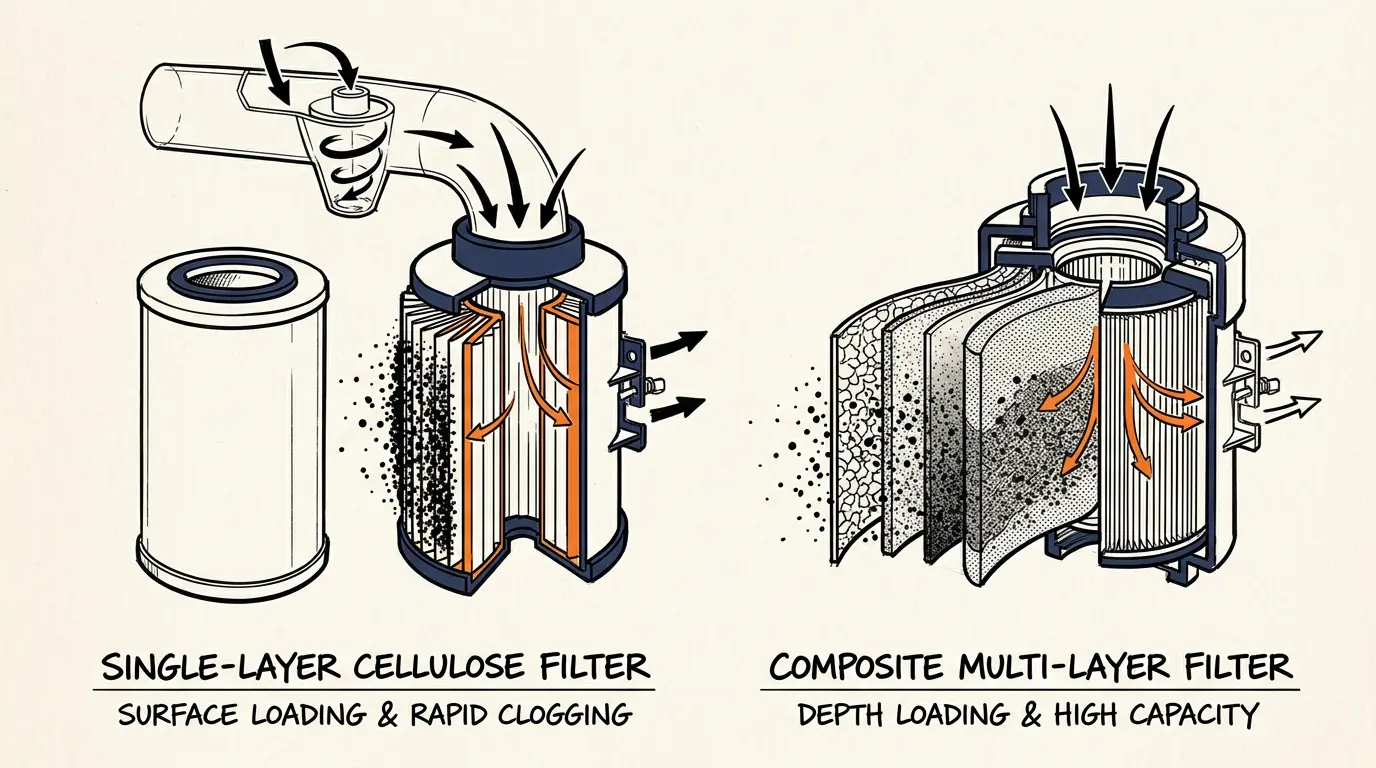
On foundry, cement, and stone-processing floors, diesel is usually forced by continuous heavy loads and no charging access. The spec that makes or breaks the truck is engine air filtration matched to your dust load.
Dust derating is a curve, not a checkbox. Double the dust concentration in the intake air and you roughly halve the filter's service interval.
A composite polyester-glass-microfiber element holds about 142.5 g/m² of dust before its pressure-drop limit, against roughly 66.9 g/m² for single-layer cellulose. That stretches service from around 16,800 km to 33,700 km — close to double.
Spec the filter against a measured dust load, not a generic harshness rating. Ambient dust at 200 mg/m³ means servicing twice as often as at 100.
The 5-ton diesel trucks I spec'd for a cement and stone operation in Turkey lived or died on filter intervals, not rated capacity — the loads never changed, the dust did.
Yuli's CPC-K diesel series lists an aging-resistant air filter for harsh environments among its build options, the item to confirm first on a dusty floor:
- Heavy-duty, multi-layer air filter sized to dust load — mandatory, with a cyclonic pre-cleaner above roughly 150 mg/m³.
- Sealed, dust-protected steering axle and connectors — standard on a well-built truck, not an upgrade.
- Heat-tolerant hydraulic fluid and an oversized cooling package for floors near molten metal.
Diesel stops being the answer in an enclosed, poorly ventilated bay under an emissions limit, where the exhaust — not the dust — sends you back to electric.
Spec'ing for Outdoor Yards and Rough Terrain
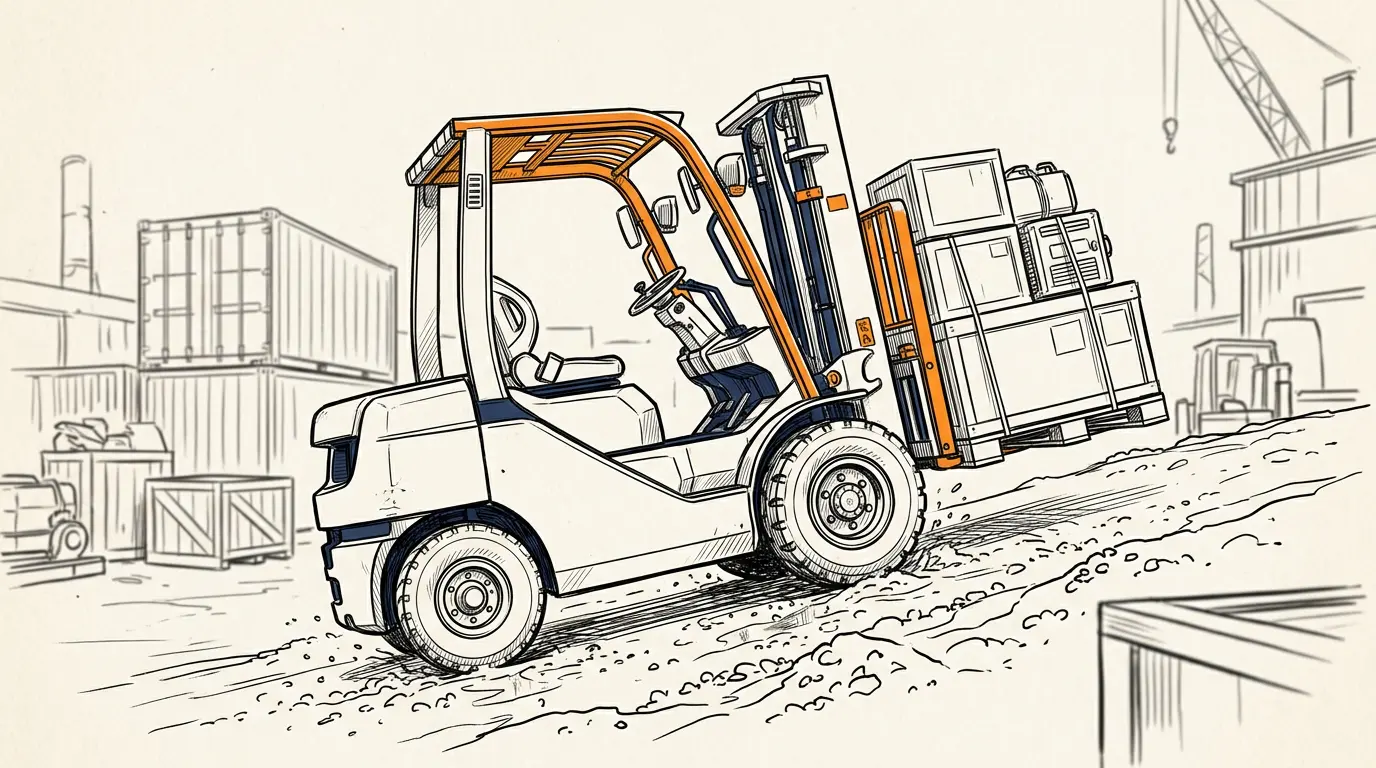
Outdoor yards and port aprons are spec'd around traction and gradeability first. The power type splits between diesel, where no charging infrastructure exists, and dual-fuel LPG for mixed indoor/outdoor runs.
Gradeability figures assume a laden truck on dry concrete. Derate them the moment the surface turns to wet gravel or a rain-slick ramp.
A 3-to-5-ton diesel unit rated near 20% gradeability climbs a standard ramp laden; on loose or wet ground, plan for less. Under a laden climb a light mast flexes and binds — the mast is where cheap trucks reveal themselves.
LPG is the one place where power type stays a genuine choice, not a forced one. A dual-fuel LPG truck and an electric truck can both satisfy a ventilated mixed operation, so buyer preference legitimately applies within the requirement floor. LPG earns its place on fast turnaround: a tank swaps in minutes where a battery needs hours.
Run LPG indoors and you owe the building 4 to 6 air changes per hour to hold carbon monoxide under its 50 ppm limit. For a zero-emission space like food or pharma handling, it is off the table entirely.
- Pneumatic or solid-pneumatic tires for unpaved ground — mandatory; cushion tires belong on smooth indoor floors.
- Gradeability rated for laden climbs, confirmed against your worst ramp and surface.
- A simple, proven drivetrain over a clever one — mechanical simplicity outlasts electronic sophistication in a dusty yard.
Which Forklift Options Are Mandatory and Which You Can Defer
Some extreme-environment options are prerequisites for the truck to finish its first season; others are upgrades you can defer. Sorting one from the other, not haggling down the package price, is where the savings sit.
The tell is whether a cost is a compliance obligation or deferrable maintenance. Ventilation and CO monitoring for an indoor LPG or diesel truck are mandatory the day it arrives — you cannot run the truck legally without them.
An electric truck's battery replacement, roughly $5,000 to $8,000 every five to seven years, is inevitable but scheduled. You plan for it; it doesn't gate day-one operation.
The common mistake is pricing an "extreme-duty package" as one lump upgrade. Half of it — a sealed steering axle, a seat-sensing lockout — is standard on any well-built truck. The other half is the real spend: the cold-storage package, the cab heater, the cold-rated fluid.
| Power type | Mandatory on day one | Deferrable or situational |
|---|---|---|
| Electric (cold) | Sealed electronics, cold-storage package | Cab heater, spare battery pack |
| Diesel (dust, heat) | Heavy-duty air filtration, cooling package | Enclosed cab, premium lighting |
| Dual-fuel LPG (indoor) | Ventilation to 4-6 ACH, CO monitoring | Fast-swap spare tanks |
The number that moves your budget is which options you called mandatory, not the fuel in the tank. When conditions mix in one shift, the mandatory list stops being obvious. Hand your measured site conditions to Yuli's engineering team for a custom build, not a standard sheet.
Which Safety Features to Specify Regardless of Environment
The personnel-safety package should be specified the same way regardless of environment or power type. The failure mode an overhead guard or an operator-presence system prevents doesn't change with temperature or dust.
Federal rules set a floor, and it sits lower than most buyers assume. OSHA 1910.178 and ANSI B56.1 require an overhead guard, a load backrest extension, and an operator-controlled horn. The guard is built to stop falling objects, not rated to withstand a full falling capacity load.
Federal rules stop short of requiring, as equipment, seat belts, an operator-presence (OPS) seat-sensing lockout, or an onboard fire extinguisher. Seat-belt use is enforced once a truck is equipped, through the general-duty clause — but equipping it is a catalog choice, not one the regulation makes for you.
So the real safety spec lives above the floor. Specify those items by choice, not as extras that scale with how harsh the site looks. The rollover an OPS system catches happens on a smooth indoor floor as readily as on a rough yard.
Federally required, so verify they are present:
- Overhead guard rated for falling objects, plus a load backrest extension
- An operator-controlled horn
Above the floor, so you specify them by choice:
- Seat belt or operator restraint
- Operator-presence (OPS) seat-sensing lockout
- Onboard fire extinguisher
- Worksite-appropriate lights and blinkers
Building the Spec, in Order
Start the spec sheet with numbers, not a truck: temperature range, dust load, duty cycle, and charging or refueling access. Let those fix the power type, split options into mandatory and deferrable, and specify the safety baseline last — identically, whichever environment you landed in.
The budget overruns come from running that sequence backward: starting with a power-type preference and bolting environment options onto it, which is how a truck ends up mismatched to its floor.
The line item buyers misjudge most sits on the safety layer, where "not federally required" quietly becomes "optional" — the one place the regulation won't catch the mistake for you.